In this section, we’ll talk about reading. You might be thinking, Reading?!? But I already know how to read. Yes, that’s true. But the point of this part of the website is to offer tips to help you become a better reader of the kinds of challenging texts you’ll be assigned in college, where professors often place a lot of responsibility on students to figure out what difficult reading assignments mean on their own. We’ll address that problem by covering some strategies to help you better understand your college reading assignments. With the right strategies, you’ll be better able to understand texts and, thus, be better able to discuss and write about them.


Difficult reading assignments
Here’s a quote from an academic research journal article about headaches by H. Macit Selekler and Faik Budak, two professors of neurology (brain scientists, basically): “Idiopathic stabbing headache (ISH) and ice cream headache occur due to paroxysmal firing of trigeminal pathways and a defect in pain control mechanisms.” That sentence is so technical that it might be enough to give the reader a headache.
In first-year composition, students probably won’t be required to read anything that insanely technical, but the reading students generally do is challenging “college-level” material.
How reading feels
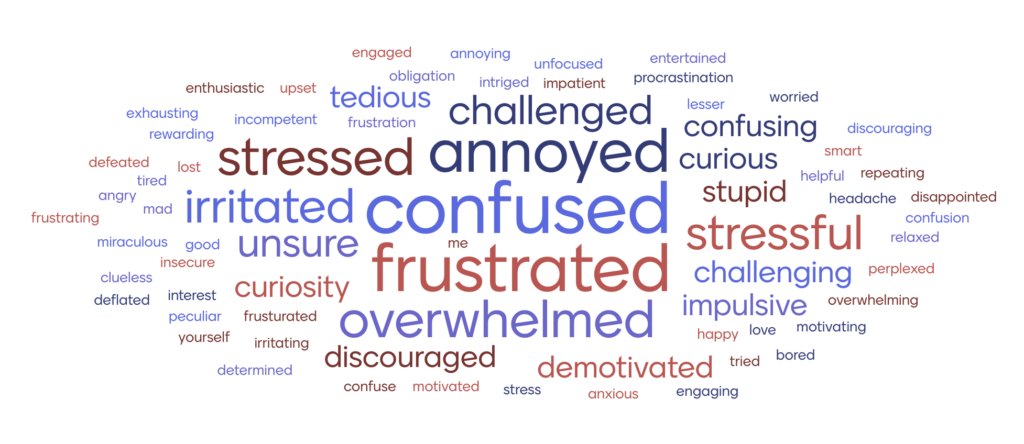
Before we go over some strategies to help students get more out of their reading, I want to briefly talk about how reading difficult stuff feels. Here’s a word cloud that my students created when I asked them how they felt when reading something difficult.
As you can see, we could safely classify most of the emotions people reported feeling as negative. (But I’m honestly very happy for the “happy,” “good,” and “rewarding.”)
Introduction to active reading
Video introduction
So, why are we being Debbie Downers and talking about how reading feels? Please watch the three-minute video to find out. The video only presents a few active reading strategies, but you can click on the link below more ideas. I suggest trying out a few different ones. Some might work better in different situations, so keep that in mind, as well.
List of active reading strategies
In first-year composition, students are generally expected to discuss and write about the texts they read, so it’s important to have a deep understanding of them. That means students who read quickly without taking notes, or who otherwise don’t their brains in some way, might not fully understand what they’re reading. The McGraw Center at Princeton University provides a helpful overview of active reading strategies that you can use to get more out of your reading. Try them out and use the ones that work best for you.Video introduction
Active reading in action
Now that that you’ve learned some basic active reading strategies, see what they look like in practice.